When a bank spends below its fair share of voice, nothing breaks immediately — the damage shows up in the P&L six to eighteen months later, once it’s too late to trace back to the decision that caused it.
Banks rarely announce that they are losing ground. There is no alarm when a marketing budget gets quietly trimmed, and no warning label on a competitor pulling ahead in share of voice. What actually happens is slower and harder to trace: a bank under-spends relative to its market position for a few quarters, nothing visibly changes, and then twelve to eighteen months later the numbers arrive — flat premium growth, a rising cost to acquire each customer, a primary-account base that has quietly stopped growing. By the time the P&L shows the damage, the decision that caused it is long forgotten.
Banks don’t lose market share loudly. They bleed it quietly.
Marketing under-investment behaves like a lagging indicator. Because brand effects take six to eighteen months to show up in acquisition and retention numbers, the spend gets cut well before any financial result reflects the damage. That lag is what makes the mistake so easy to repeat: the bank that under-invests this quarter is not punished this quarter, so nothing in the immediate results tells anyone to reverse course. By the time it shows up, the instinct is to blame the market, not the marketing plan that missed it eighteen months earlier.
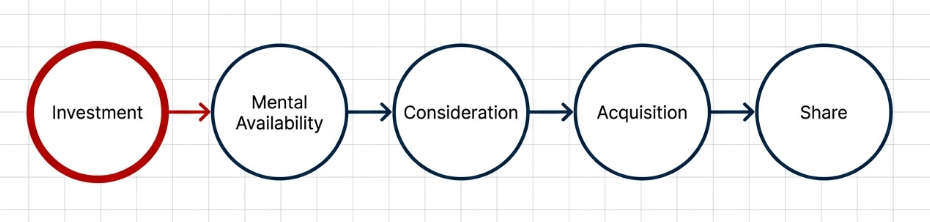
The real driver is the gap between what you spend and what you hold
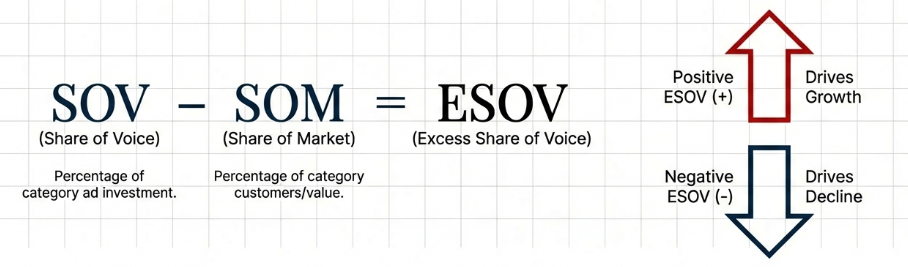
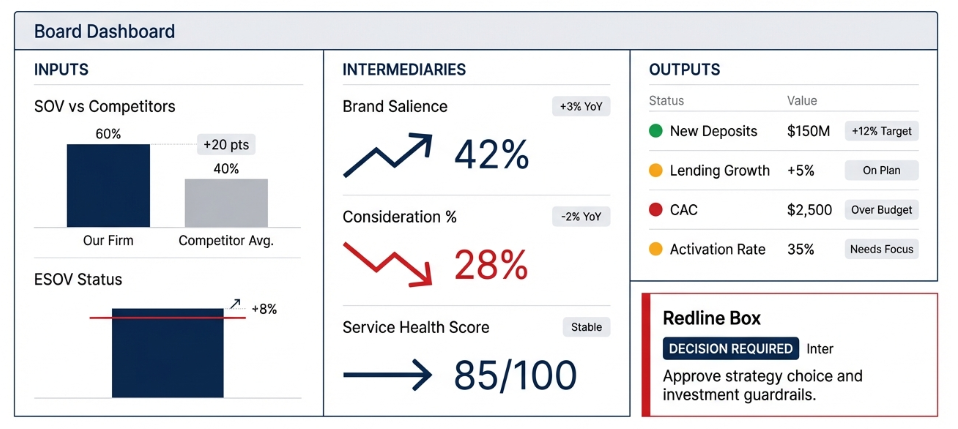
The pressure a bank feels to grow is created by the delta between its share of voice — the proportion of category advertising it owns — and its share of market. When spend consistently trails market share, that gap becomes a structural drag on growth rather than a one-off dip. The variable worth tracking is Excess Share of Voice, or ESOV: how much more (or less) of the category’s attention a brand buys relative to the market share it already holds. A bank running negative ESOV for several quarters running is, in effect, financing its competitors’ growth.
Brand investment buys future demand at a discount
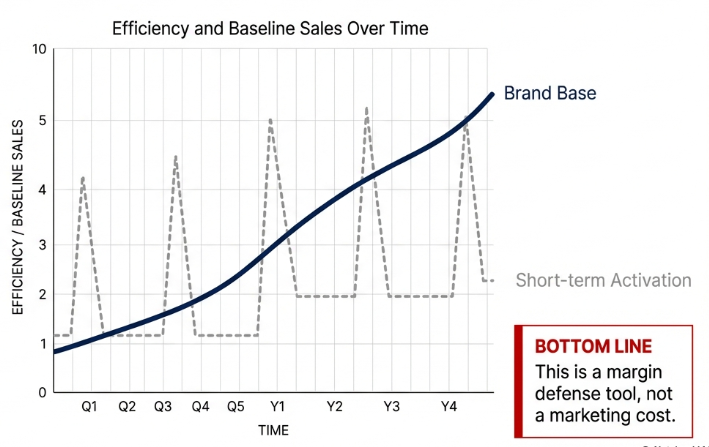
Spending ahead of the market is not vanity investment — it is a way of buying future demand before it becomes expensive to capture. Sustained brand presence protects long-term margins because it lowers the customer acquisition cost a bank will otherwise pay later, when it has to outbid competitors for the same attention with performance media alone. Marketing that only shows up when a customer is already searching is buying demand at its most expensive moment, not creating it while it is still cheap.
ESOV predicts direction, not certainty
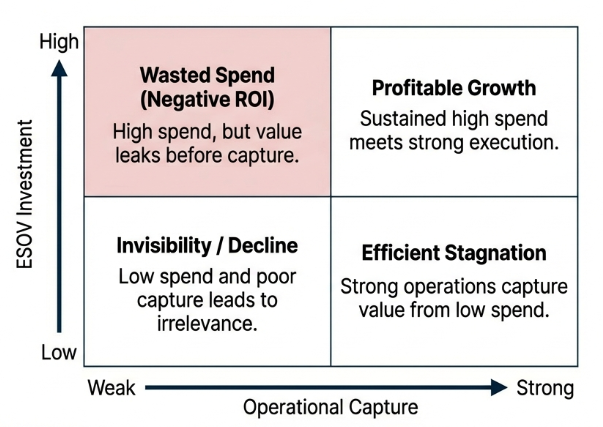
None of this makes ESOV a guarantee. It is best used as a planning heuristic — a signal of which direction growth pressure is likely to move in — rather than a precise forecast, because the actual magnitude of the effect still depends heavily on execution: creative quality, channel mix, and how well the bank’s operations can absorb the demand the spend creates. Two banks running identical ESOV can see very different outcomes if one converts that attention into accounts and the other lets it leak away in the application process.
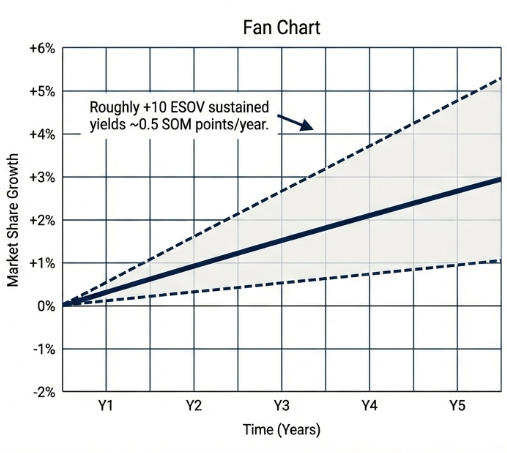
If capture fails, ESOV becomes wasted spend
That last point is the one boards most often miss: marketing creates intent, but it is the bank’s own systems — onboarding flows, call centre capacity, underwriting turnaround — that have to convert it without friction. Positive ESOV spent against a broken capture process does not produce growth; it produces an expensive spike in abandoned applications. Before increasing spend, it is worth confirming the organisation can actually catch the demand it is about to generate.
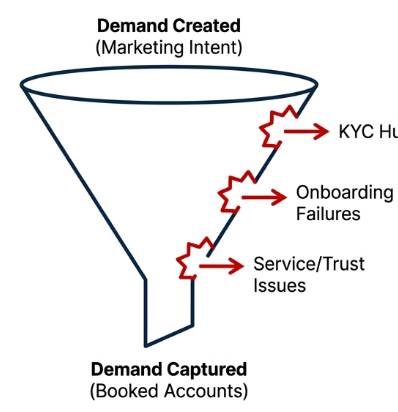
High spend with weak operations destroys ROI
There are a handful of recognisable ways this system breaks down — spend without positioning, positioning without operational capacity, capacity without follow-through, and so on — and the first job of any growth review is identifying which one a given bank is actually living in, rather than assuming more budget alone will fix it.
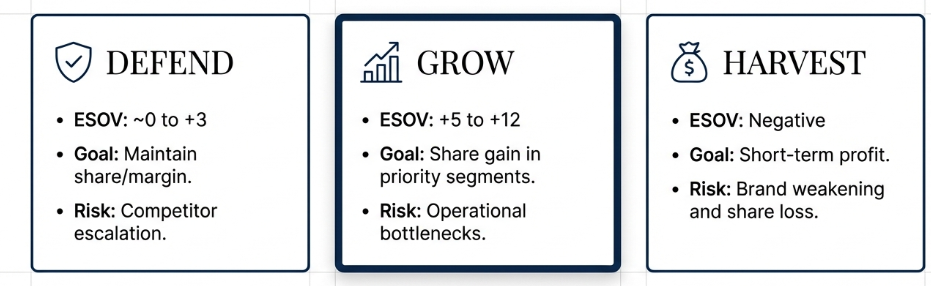
Three legitimate strategies. Pick one.
Once the diagnosis is clear, a bank is really choosing between three legitimate stances: invest ahead of the market to take share, hold spend to defend the position it already has, or deliberately harvest a mature position for cash while accepting slow decline. Each is defensible on its own terms. What is not defensible is drifting between them by default, because ambiguity is itself a decision — and the default outcome of an undecided strategy is quietly becoming a harvest strategy, share point by share point, without anyone having chosen it.
Run this like a business system
Treating brand investment as a system rather than a campaign means reviewing it on the same cadence as any other capital allocation decision: quarterly, and assessing demand generation, capture performance, and commercial outcomes together rather than in separate reports that never get read side by side.
What happens when a bank goes dark
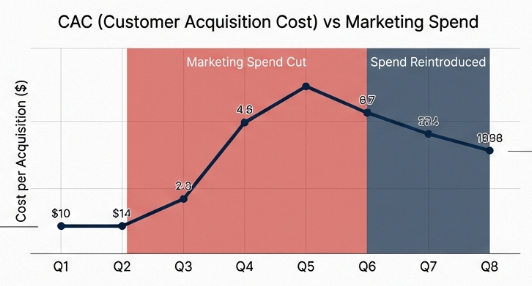
One Tier 1 bank tested the theory involuntarily: it cut marketing spend to near-zero for twelve months. Results held for the first two quarters — the lagging-indicator effect at work — then degraded sharply in the third. Customer acquisition cost rose by 40%, churn increased, and competitors picked off the bank’s primary-account holders while its share of voice sat at zero. The correction was as instructive as the failure: reintroducing a base-plus-burst spending pattern — a steady always-on floor topped up with periodic bursts — rebuilt the position, but slower than it had taken to lose it. Quiet decline, it turns out, is much easier to enter than to reverse.