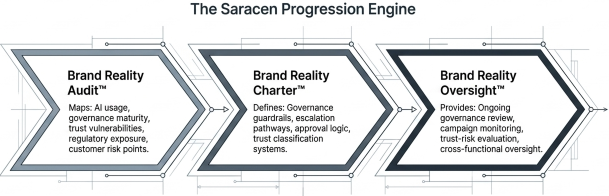
The next competitive advantage in financial services will not come from who automates fastest. It will come from who stays most trusted while scaling automation — and most institutions are optimising for the wrong half of that equation.
Artificial intelligence has made financial communication faster to produce and, at the same time, considerably harder to verify. A generated message can look and read exactly like one a compliance-trained human wrote, which means the institutions racing to deploy AI across marketing, service and advice are simultaneously racing ahead of their own ability to verify what those systems are actually saying to customers. The next competitive advantage in financial services will not go to whoever automates fastest. It will go to whoever stays most trusted while scaling that automation — and right now, most institutions are optimising for the wrong half of that equation.
The greatest AI risk in banking is not efficiency failure — it is trust failure
Most financial AI programmes are measured by how many transactions or interactions they can process, not by whether they preserve the trust those transactions depend on. That is a meaningful blind spot, because automation alone does not create a stronger financial institution — it only creates a faster one. Speed without a corresponding increase in verification is simply risk moving faster too.
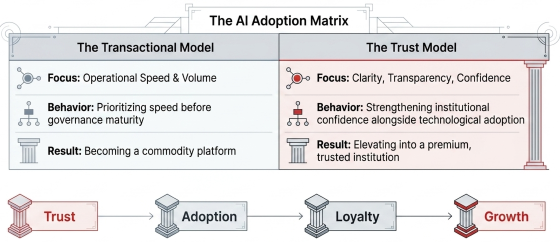
Consumers are already skeptical, and AI raises the stakes
Financial trust now operates inside a consumer environment that assumes a company might be automating without disclosing it, and reacts accordingly the moment something feels off. Deploying AI into that environment without a governance layer is not a neutral choice — it is a decision to let the first visible mistake set the narrative.
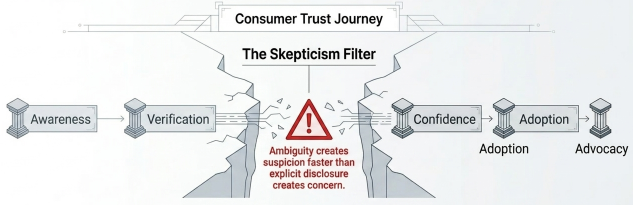
Trust failures compound faster than technology failures
A technology failure is usually contained to the system that broke. A trust failure is not — poor AI governance creates simultaneous exposure across brand perception, customer relationships, operational continuity and regulatory standing, all from a single incident. That is what makes trust failures disproportionately expensive relative to their apparent size at the moment they happen.
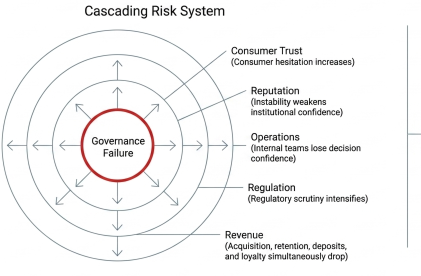
The risk is usually created before anything launches
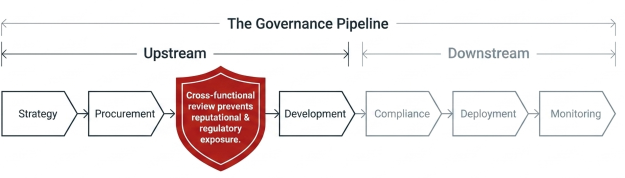
By the time a customer-facing AI tool goes live, most of its trust vulnerabilities were already locked in earlier — during strategy discussions, campaign briefing, vendor selection, or workflow design, long before anyone was reviewing outputs. Reviewing the finished product catches surface issues; it rarely catches the ones built into how the tool was scoped in the first place.
AI governance is now a leadership issue, not an IT one
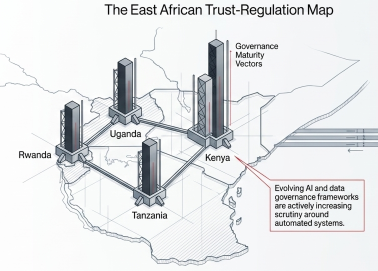
Because the exposure spans brand, customer, operations and regulation at once, AI governance in financial services has moved out of the technology function and into the leadership team’s direct responsibility. Delegating it purely downward is itself a governance failure.
Not every use of AI carries the same trust risk
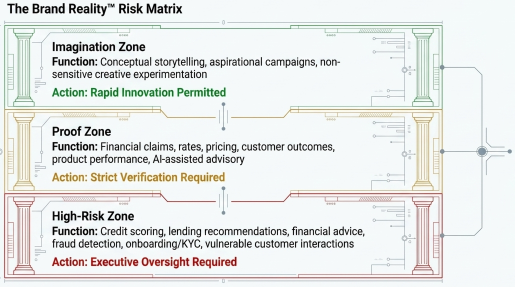
The goal is not to slow innovation down uniformly — it is to make sure governance maturity scales with trust sensitivity, so that a low-stakes use case (say, generative creative exploration) is not held to the same review bar as a high-stakes one (credit scoring, lending recommendations, KYC). This is the logic behind the Brand Reality™ Framework, which sorts AI use into three zones: an Imagination Zone for conceptual storytelling and non-sensitive creative experimentation, where rapid innovation is genuinely fine; a Proof Zone covering financial claims, rates, pricing and customer outcomes, which requires strict verification before anything ships; and a High-Risk Zone spanning credit scoring, lending recommendations, financial advice and vulnerable-customer interactions, where nothing moves without executive oversight.
Trust governance requires operational infrastructure, not good intentions
The institutions that win the next phase of this shift will not simply deploy more AI than their competitors. They will build AI-enabled ecosystems that customers and regulators trust more — which means treating governance as infrastructure to be built deliberately, not a policy to be issued once and left unmaintained.